Loading your feed…
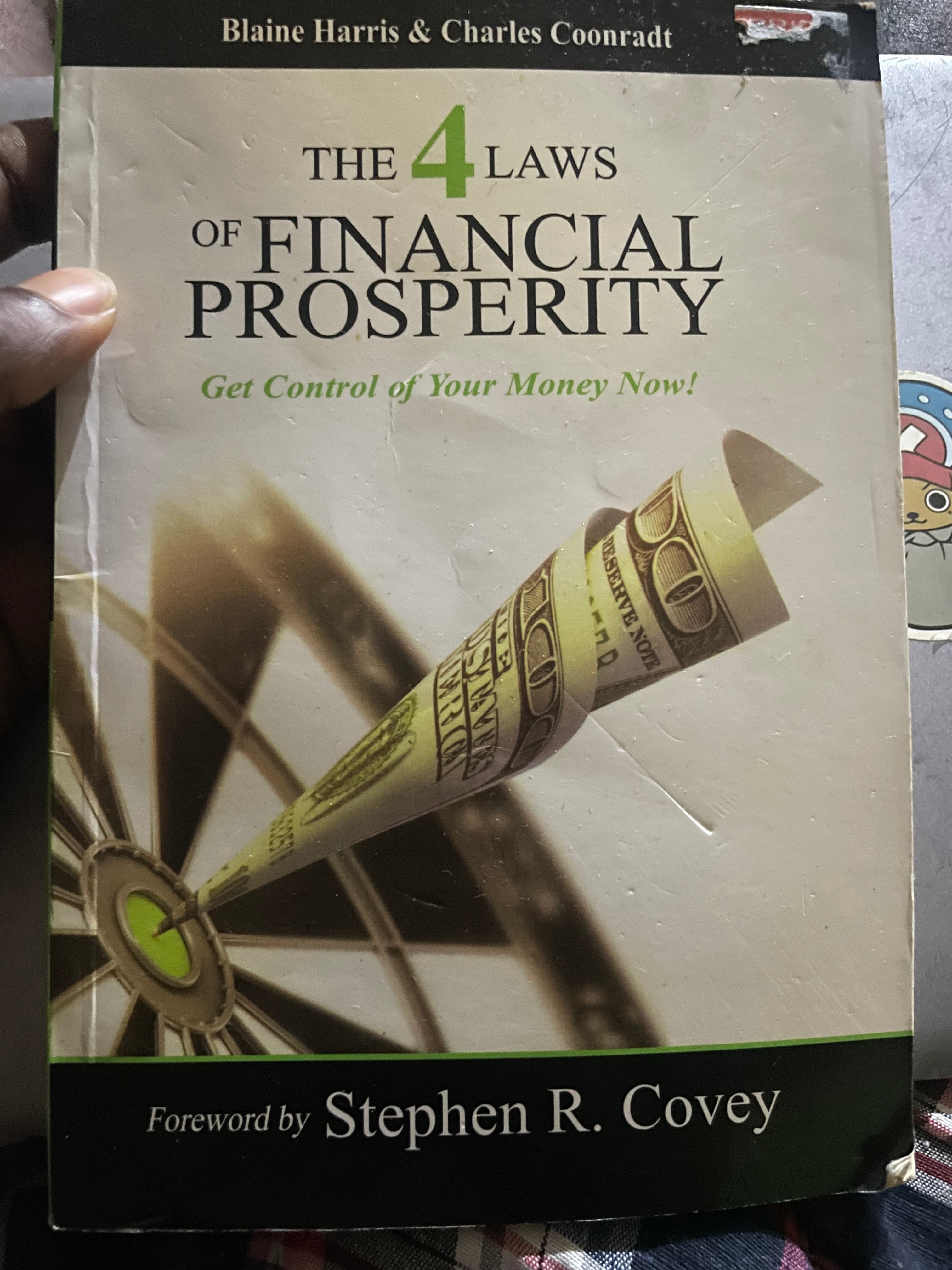
There are books you read and forget days later, and there are others you fall in love with immediately. One of those unforgettable books is The 4 Laws of Financial Prosperity.
On April 11, 2026, the day before my graduation from Christ Pillar Bible College, my mom decided to celebrate with a gift of books. She got me four, and one of them was Right and Wrong Thinking by Rev. Kenneth E. Hagin. I finished that one the same day.
Months later, on a quiet Sunday, I finally picked up the other book to see what it was about. Little did I know it was a hidden treasure.
Disclaimer: I’m only reporting on a book here, not writing for academic purposes. My goal is simply to nudge us toward the principles it teaches.
The Story Behind the Lessons
The book unfolds across thirteen chapters built around four major laws, and it’s told through the story of a financially troubled man named Paul Smith. Paul was a sales rep for a furniture manufacturer, struggling to pay his bills and feed a family of four. He couldn’t make sense of his taxes, and couldn’t figure out why his finances kept spiraling.
One evening, terrified of being jailed by the IRS, Paul decided to ask his wealthy elderly neighbor for a loan. You know the type, the kind of rich where their wealth practically radiates off the page. That’s exactly how she was described.
With his pride set aside, Paul went to her, cap in hand. She invited him in for a game of chess and told him her own story, how she once dumpster-dived to feed her children after her husband died, and how she clawed her way out of that same struggle.
She credited her wealth to four principles, and offered to teach them to Paul. Debt-ridden and desperate, he was far more interested in the money than the lesson, so she made him an offer. She would loan him two million dollars if he could demonstrate real understanding of the principles.
I know you’re eager to find out what they are. I was too, flipping through the pages. But you don’t expect me to give up the secret that easily, do you? Since we’re friends though, here they are.
1. Tracking
Most of us, myself included, don’t grasp how much tracking our daily expenses actually matters. It seems small, even a waste of time, but it’s often the first sign that something in our finances is leaking and needs fixing.
Back in school, I had a habit of snacking whenever I got bored, wandering to the buttery for something small. I didn’t realize until much later that those little purchases (three galas, a Pepsi, chewing gum, maybe a coaster biscuit) were quietly costing me around 3,000 naira a day. Over a week, that’s roughly 21,000 naira gone.
So many of us keep paying for subscriptions we no longer use, or bleed money in small ways we never notice, simply because we never track what comes in and what goes out. The book made a strong point here: the brain is our most underused financial tool, capable of pulling us out of crisis, but only if we feed it data the way we would feed information into a computer.
“If you cannot measure it, you can’t manage it.” — George Odiorne
2. Targeting
No financial crisis lifts without a targeted goal. As Paul Meyer put it, personal goal setting is the strongest force in the world. Maybe our biggest challenge isn’t a lack of money but a lack of a realistic goal, or any goal at all. A realistic goal might be becoming debt-free, more stable, more flexible, and prepared for retirement, not suddenly making fifty million naira from a job that pays two hundred thousand a month.
The book laid out what a real goal should look like:
• It must be written down, since an unwritten goal is really just a wish
• It must be your own, because financial freedom looks different for everyone
• It must be stated positively, focused on freedom rather than fear
• It must be measurable and specific, expressed in the clearest terms possible
• It needs a deadline
• It should reflect the kind of person you’re becoming
• It works better when it carries real benefits and rewards
• Above all, it has to be realistic and attainable
What I love about this framework is how easily it applies to almost any area of life, not just finance. I’d encourage you to pick a goal, write it down, and start working toward it.
3. Trimming
For a long time, I pictured millionaires as frugal, almost stingy people, denying themselves the good things in life just to watch a few extra zeros pile up in their account. I was wrong.
Trimming simply means living below what you earn and using the difference to escape debt and build assets that grow in value. Budgeting isn’t deprivation. Choosing to cut back on pleasure isn’t a loss of satisfaction, it’s a deliberate investment in your future.
The book echoes a principle you’ll also find in Rich Dad Poor Dad: pay yourself first. That means setting aside ten percent of every income, dedicated to paying off debt or building appreciating assets. You don’t need a loan from someone else when you can loan yourself money from your own income.
As for debt itself, the book made an important distinction. Debt tied to something that doesn’t grow in value, like a loan for pleasure, is very different from debt tied to something that appreciates, like property. Not all debt is bad debt. Some takes from you, and some gives back.
4. Training
This law is about the discipline of continuous learning, understanding investment strategies, stock markets, securities, and real estate, and building the kind of knowledge that can turn wealth into something lasting. You simply cannot grow beyond what you know.
Picture this:
• You track your expenses and discover you’re losing 21,000 naira a week to small leaks
• You earn minimum wage, say 77,000 naira, and commit 10 percent (7,700 naira) to savings
• Add that to the 21,000 you plug from tracking, and you’ve freed up 28,700 naira
• A 100,000 naira debt could be cleared in about three months
• Keep going, and that same 28,700 naira could buy you 52 shares in Dangote Refinery
Now imagine training yourself to earn an extra 50,000 naira a month, while trimming keeps your expenses from creeping back up. That’s how small, consistent habits quietly make the wealthy wealthier.
Now that I’ve shared my newly discovered secret, the least you can do is follow me for more book insights like this one. What I loved most about this book is that it never told me to simply save more, spend less, or chase more income to become wealthy. Instead, it pointed me toward blind spots I had completely overlooked, ones that could genuinely build my wealth over time.
Rating: 8/10 on the basics of prosperity, and I’ve already started putting its ideas into practice.
— Oluwaferanmi Adebayo


No comments yet. Start the conversation.