Loading your feed…
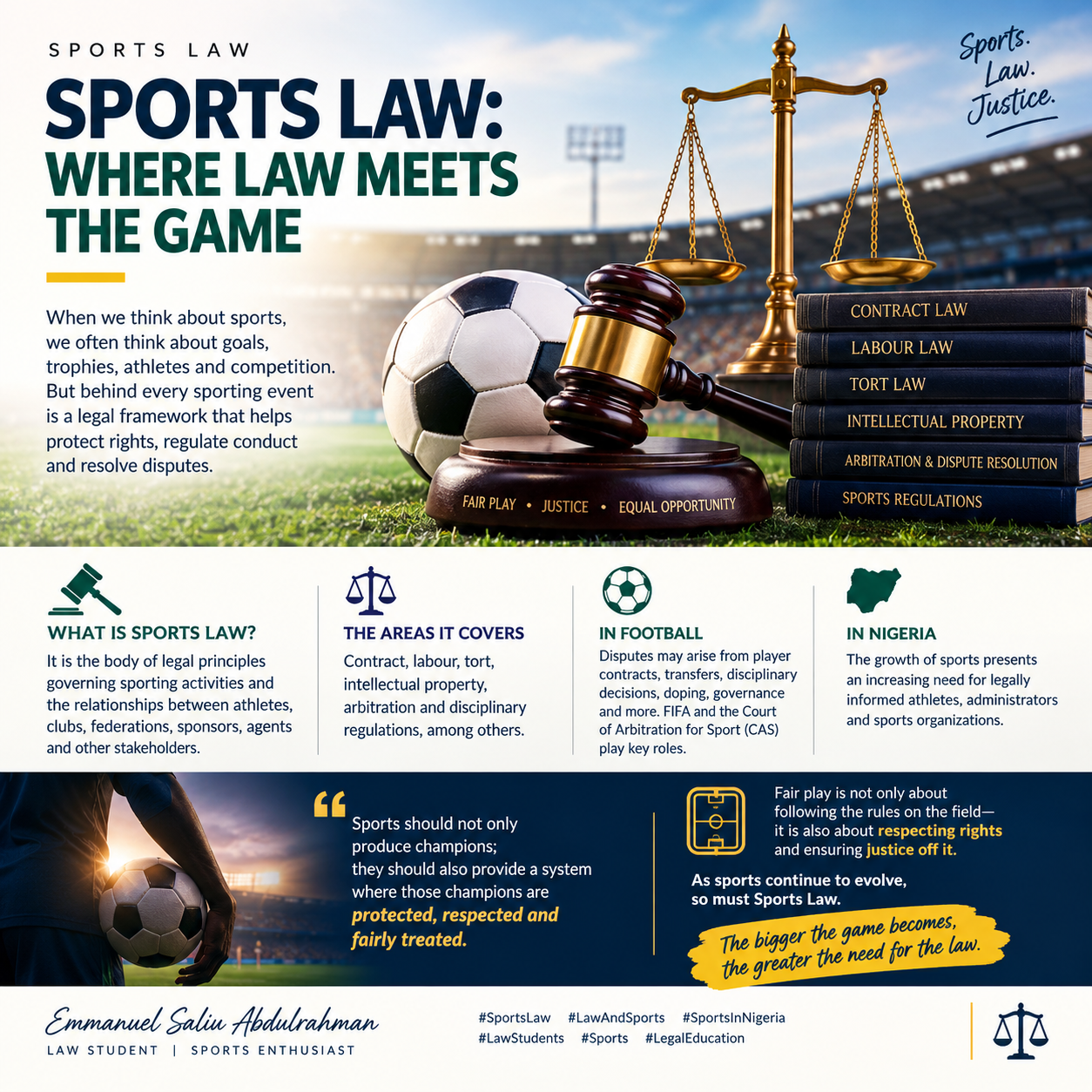
When we hear the word sports, our minds often go straight to football pitches, trophies, athletes, supporters and exciting competitions. But behind every successful sporting event lies a system of rules, regulations, contracts and legal responsibilities.
This is where Sports Law comes in.
What is Sports Law?
Sports Law refers to the body of legal principles and rules governing sporting activities and the relationships between athletes, clubs, coaches, federations, sponsors, agents and other stakeholders.
Interestingly, Sports Law is not limited to one particular area of law. It brings together several branches of law, including contract law, labour law, tort law, criminal law, intellectual property law, arbitration and dispute resolution.
In simple terms, Sports Law determines how the game should be played—not only on the field, but also in the legal and administrative environment surrounding it.
Why is Sports Law Important?
The modern sports industry is no longer simply about recreation. Sports have become a major economic and commercial sector.
Professional athletes enter employment and sponsorship agreements. Clubs negotiate transfers. Sponsors protect their brands and intellectual property. Governing bodies establish disciplinary regulations, while athletes may challenge decisions affecting their careers.
Without appropriate legal rules, these relationships could easily become chaotic.
Sports Law therefore helps to promote fairness, accountability, transparency and the protection of rights.
Football and the Law
Football provides one of the clearest examples of the relationship between law and sports.
In Nigeria, football is regulated through a combination of national law, regulations of sporting bodies and international sporting rules. At the international level, FIFA establishes regulations governing matters such as player status and transfers, while national football authorities administer the sport within Nigeria.
Disputes may arise between players and clubs, clubs and governing bodies, or other stakeholders. Depending on the applicable rules and agreements, some disputes may be resolved through internal disciplinary mechanisms, arbitration or, where jurisdiction exists, the Court of Arbitration for Sport (CAS).
Challenges Facing Sports Law in Nigeria
Despite the growth of sports in Nigeria, several legal and institutional challenges remain.
Some of these include:
i. Contractual disputes between athletes and clubs;
ii. Weak enforcement of sporting regulations;
iii. Doping and other forms of cheating;
iv. Match-fixing and corruption;
v. Disputes concerning player transfers;
vi. Inadequate protection of young athletes;
vii. Discrimination and harassment in sports;
viii.Poor governance and accountability within sporting organizations.
These challenges show that Nigeria needs not only talented athletes but also strong legal institutions and legally informed sports administrators.
The Nigerian Perspective
Nigeria has enormous sporting potential. From football and athletics to basketball and other emerging sports, Nigerian athletes continue to demonstrate their abilities nationally and internationally.
However, sporting success should not be measured only by medals and trophies. There must also be proper structures to protect the people who make sports possible.
Athletes should understand their contractual rights. Clubs should understand their obligations. Administrators should understand the limits of their powers, and disputes should be resolved through fair and transparent procedures.
This is where lawyers with knowledge of Sports Law can play an increasingly important role.
The Future of Sports Law
As Nigerian sports become more professional and commercially valuable, the demand for Sports Law will inevitably increase.
There is therefore a need for greater legal education among athletes, coaches, administrators and sports organizations. Universities and professional institutions should also encourage the study and development of Sports Law as a specialized area of legal practice.
The future of Nigerian sports should not only be about producing champions; it should also be about creating a system in which those champions are protected, respected and fairly treated.
Final Thoughts
Sports may be played on the field, but many of the most important battles surrounding sports are fought through contracts, regulations, disciplinary procedures and legal institutions.
Sports Law reminds us that fair play is more than following the rules of the game. It also means protecting rights, ensuring justice and holding institutions accountable.
As sports continue to evolve, one thing is certain:
The bigger the game becomes, the greater the need for the law.
And in Nigeria, the development of a strong Sports Law culture could be one of the keys to building a more professional, transparent and successful sporting industry.
No comments yet. Start the conversation.