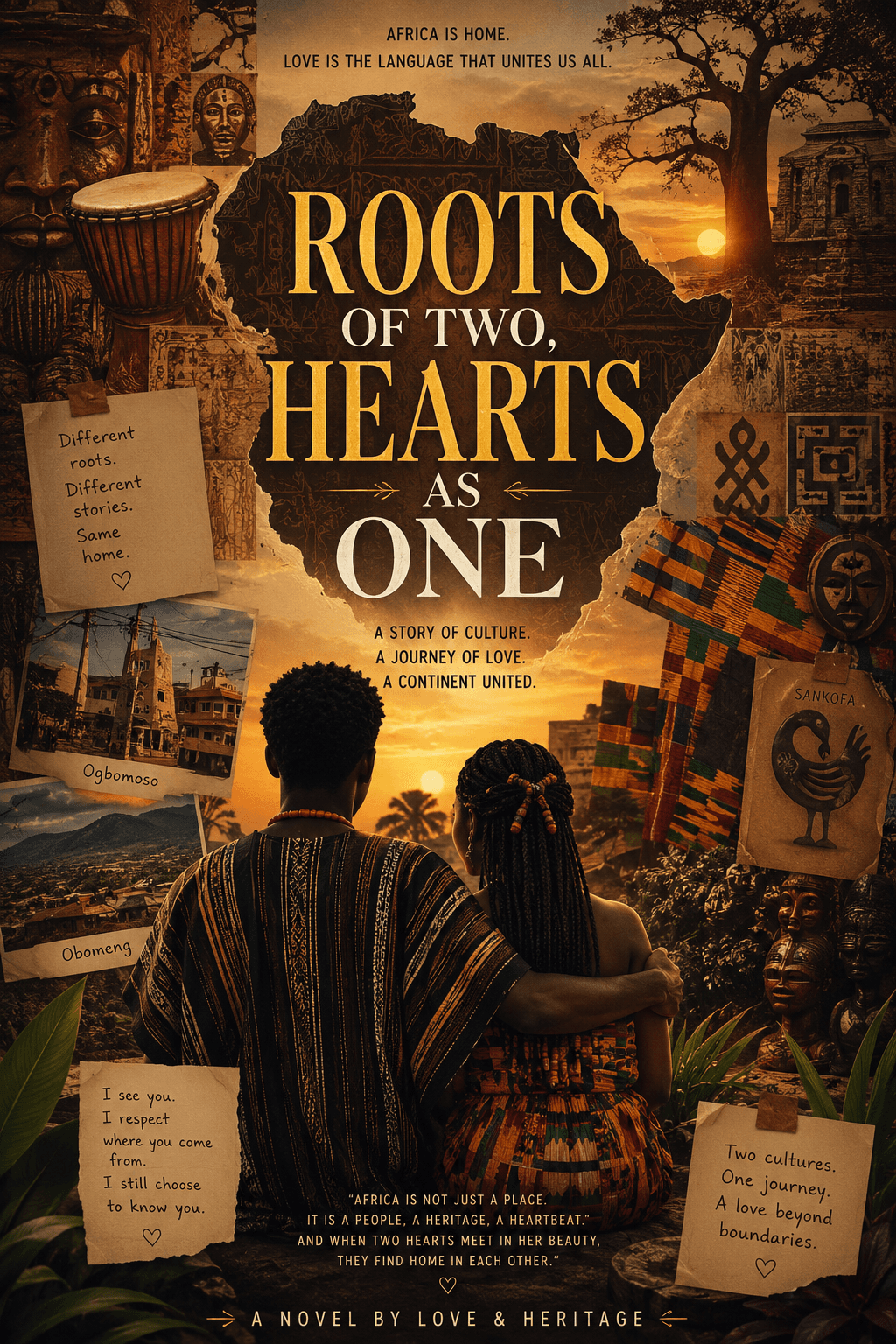
They had become close without ever deciding to.
It happened in pieces.
Lunches that were supposed to last twenty minutes and somehow became two hours. Walks across campus that took longer because neither of them seemed interested in getting where they were going. Little trips outside campus. Random errands that became outings. Conversations that started with something completely ridiculous and ended with one of them telling the other something they hadn't intended to say.
There were days they barely spoke.
There were others when they talked until their voices became tired.
Somewhere in between, Aderemi became Remi.
Only to her.
She had never asked if she could call him that. It simply happened one day, and he never corrected her.
She liked that.
Maybe because it felt like something that belonged only to them.
By then, being around him no longer felt like an event.
It felt natural.
And perhaps that was how closeness really happened.
Not loudly.
Not all at once.
Just little by little, until someone's presence became something you began to look for without realising you were looking.
They were given a project to work on about African heritage from places of their choice.
Their project was supposed to be simple.
It wasn't.
The more they researched African heritage, the more ridiculous their original plan began to seem.
How could they fit a continent into a few pages?
How could they talk about Africa without reducing her to the things outsiders already expected to see?
The more they looked, the more they found.
Languages.
Kingdoms.
Clothing.
Music.
Food.
Art.
Stories.
Traditions.
And beneath all of them, people who had kept those things alive.
One afternoon, Sena shut her laptop.
“We're doing this badly.”
Remi looked at her.
“That's dramatic.”
“We're trying to explain Africa from the internet.”
He leaned back.
“So?”
“So I think we should actually go somewhere.”
“Somewhere?”
“Somewhere that matters.”
He watched her for a moment.
“Where?”
She smiled.
“Your hometown.”
He raised an eyebrow.
“Ogbomoso?”
“Yes.”
“You're serious?”
“Very.”
He smiled.
“Then you're coming with me.”
Ogbomoso
Ogbomoso was different from the campus she had known him in.
Maybe because here, he wasn't simply Remi.
He was someone's son.
Someone's grandson.
Someone's child.
The boy who had grown up knowing which roads led home and which voices belonged to which family.
The moment they stepped into his grandmother's compound, an older voice came from inside.
“Aderemi, ọmọ mi, nibo ni o ti pẹ́ sí?”
He laughed.
“Ma, I'm here.”
His grandmother stepped outside, shaking her head.
“Ó ti pẹ́ gan-an o.”
He smiled.
“I know, Ma.”
She looked at him for a moment before turning her eyes towards Sena.
There was a brief pause.
Then her face softened.
“Ẹ káàbọ̀, ọmọ mi. Ṣé àlàáfíà ni?”
Sena smiled.
“I'm fine, ma.”
His grandmother laughed softly.
“Good. Come inside.”
Sena followed.
Remi leaned towards her.
“You survived your first Yoruba greeting.”
She whispered,
“I barely understood anything.”
“You'll learn.”
His grandmother turned around immediately.
“Mo gbọ́ ohun tí ẹ ń sọ.”
Remi froze.
Sena looked at him.
“What did she say?”
His grandmother laughed.
“He thinks I don't understand English.”
Remi shook his head.
“This is why I don't talk around her.”
Sena laughed.
And just like that, the awkwardness disappeared.
His grandmother didn't teach Sena Yoruba like it was a lesson.
She simply spoke.
She corrected her pronunciation when she tried.
She explained things when Sena asked.
She told stories while preparing food.
She laughed at Remi.
Scolded him.
Praised him.
Embarrassed him.
Loved him.
And Sena watched.
Because sometimes, you learnt a culture not from someone explaining it to you, but from watching how people loved one another.
She began noticing the little things.
The way Remi greeted older people.
The way his grandmother's voice changed when she spoke about family.
The way stories were never simply stories.
There was always something underneath them.
History.
Memory.
Instruction.
Identity.
She began to understand that culture wasn't something people only wore during festivals.
Sometimes it was sitting in an old woman's kitchen.
Sometimes it was a language passed between generations.
Sometimes it was a recipe remembered without measurements.
Sometimes it was a story that survived because somebody kept telling it.
They explored Ogbomoso slowly.
Not as tourists.
As two people trying to understand a place that had helped shape one of them.
Remi told her about the history of the town, about the Soun dynasty and the stories surrounding Ogunlola. His grandmother added her own versions of things, occasionally correcting him when his memory failed him.
Sena listened.
She asked questions.
Lots of them.
Sometimes Remi knew the answer.
Sometimes his grandmother did.
Sometimes they searched for it together.
And Sena liked that nobody pretended to know everything.
They were simply learning.
They saw traditional performances.
She listened to drums whose rhythms seemed to carry something older than the moment itself.
History.
Celebration.
Memory.
Community.
She looked at Remi.
“Do you ever think about how much has survived?”
He looked at her.
“What do you mean?”
“All of this.”
She gestured around them.
“The language. The music. The stories. Everything.”
He was quiet.
Then said,
“Maybe that's what we do.”
“What?”
“Keep things.”
She smiled.
“That's a very simple way to describe Africa.”
“Maybe simple isn't always wrong.”
She looked at him.
For once, she didn't have an answer.
One afternoon, Sena spent almost an hour trying to pronounce a Yoruba word his grandmother had taught her.
She tried again.
Remi laughed.
She frowned.
“What?”
“You're saying it wrong.”
“I've tried it six times.”
“And you've been wrong six times.”
She stared at him.
“You're not helping.”
He smiled.
“Come here, Orekelewa.”
She stopped.
“What?”
He shrugged.
“Nothing.”
“No. What did you call me?”
He smiled.
“Orekelewa.”
“What does that mean?”
“Why do you want to know?”
“Because you just called me something!”
He laughed.
“You'll find out.”
She narrowed her eyes.
“Remi.”
“Yes?”
“You're annoying.”
“I know.”
She didn't know then that the name would stay.
She would learn its meaning later.
Beautiful one.
And somehow, she liked that he had chosen to give it to her there.
In the place where she had begun to see not just the boy she knew, but the world that had made him.
The more time she spent there, the more she understood something.
A person could carry an entire history and still walk around looking ordinary.
Africa did that too.
She had been called beautiful.
Ancient.
Developing.
Exotic.
Rich.
Poor.
But no single word had ever been large enough to contain her.
Perhaps that was her beauty.
Africa was never one thing.
She had always been many things at once.
Then Ghana became his turn.
Her turn to introduce him to the places that had made her.
Obomeng.
Her family.
Her mother's voice calling her name from across the house.
The food she knew without needing to ask what it was.
The language that sounded different when spoken by people who had known it all their lives.
This time, Remi was the one asking questions.
And Sena enjoyed it more than she admitted.
Her mother watched him carefully.
Then, one evening, she caught Sena smiling at him.
She said nothing.
Just smiled to herself.
Sena noticed.
“Mum.”
“What?”
“Nothing.”
“Exactly.”
Remi laughed.
Sena wanted the ground to open.
She showed him another side of Ghana.
The Kwahu heritage she had grown up around.
The importance of community.
Traditional leadership.
The way celebrations could bring people home from places far away.
The way a town could feel like an extension of family.
She took him through Obomeng, and for once, she wasn't the one trying to understand.
She was explaining.
This was her history.
Her inheritance.
Her world.
And he listened.
Really listened.
That mattered to her more than she expected.
He didn't compare it to his.
He didn't try to make it familiar.
He simply allowed himself to learn.
And Sena realised how rare that was.
To be loved without having to translate yourself into something easier to understand.
Then came the cloth.
She showed him Kente.
He expected something beautiful.
He didn't expect something that could speak.
She explained the weaving, the patterns, the colours and the meanings carried through different designs and traditions.
He looked at the fabric again.
“So people can wear history?”
“Sometimes.”
He smiled.
“Your people don't make anything simple.”
She laughed.
“Neither do yours.”
“Fair.”
Later, she showed him Adinkra.
The symbols weren't merely patterns.
They carried ideas.
Wisdom.
Values.
Warnings.
Hope.
She pointed to Sankofa.
He listened as she explained the idea of looking back to retrieve what is valuable and carrying it forward.
He studied the symbol.
“So you can look backward without becoming stuck there.”
“Yes.”
He nodded.
“That's actually beautiful.”
She smiled.
“That's Africa.”
He looked at her.
“What is?”
“The ability to remember without refusing to become something new.”
For a moment, neither spoke.
Then he smiled.
“Now that sounds like you.”
She looked away.
“Don't start.”
“I'm serious.”
“I know.”
And somehow, that was worse.
By the time they returned to the project, their notes had become almost irrelevant.
They had photographs.
Stories.
Recordings.
Names.
Memories.
But more importantly, they had seen something.
Ogbomoso had not made Africa smaller.
Ghana had not made her more understandable.
If anything, they had made her larger.
Because the more they discovered, the more they realised there was still to discover.
Yoruba was not Africa.
Ghana was not Africa.
Obomeng was not Africa.
Ogbomoso was not Africa.
They were pieces.
Beautiful pieces.
Different pieces.
And somehow, they belonged to the same whole.
That was Africa's strange brilliance.
She did not need her children to be identical to call them hers.
Her diversity had never been a crack in her identity.
It was her identity.
And perhaps love was not so different.
Maybe two people did not have to come from the same place to understand home.
Maybe sometimes, home was simply the willingness to enter someone else's world without asking it to become yours first.
They sat together that evening, going through the photographs they had gathered.
Ogbomoso.
Obomeng.
His grandmother.
Her mother.
The fabrics.
The streets.
The faces.
Two worlds that had once existed separately now lived side by side on the same screen.
Sena smiled at one of the pictures.
“It feels strange.”
“What does?”
“How different everything is.”
Remi looked at her.
“Different?”
“Your world and mine.”
He nodded.
“They are.”
She expected him to say something else.
Instead, he smiled.
“I like that.”
She looked at him.
“Why?”
“Because if everything was the same, what would there be to learn?”
She smiled.
Maybe that was it.
Maybe they had been looking at Africa the wrong way.
They had spent weeks discovering differences.
Different languages.
Different traditions.
Different histories.
Different ways of dressing.
Different ways of celebrating.
Different ways of saying welcome, thank you, come home.
But none of those differences had pushed them apart.
If anything, they had pulled them closer.
She had learnt to listen to his Yoruba without wishing it sounded like her own language.
He had learnt to appreciate the traditions she had grown up with without comparing them to his.
She had stood in his grandmother's home and felt welcomed into something that existed long before she did.
He had stood in her mother's home and allowed himself to become a stranger for a while, to listen, to learn, to be taught.
Neither of them had needed the other to become less of themselves.
They had simply made room.
And perhaps that was the beauty of Africa.
She had never been one story.
She had never needed to be.
She was Yoruba and Ghanaian.
Igbo and Zulu.
Ewe and Hausa.
Maasai and Amhara.
Thousands of peoples.
Thousands of languages.
Thousands of traditions.
Different enough to be distinct.
Connected enough to belong.
Her diversity was not evidence of division.
It was evidence of abundance.
Sena looked at Remi.
“You know what I like most?”
“What?”
“We didn't have to become the same.”
He smiled.
“No.”
“We just had to understand each other.”
He looked at her for a moment.
“Maybe that's what makes it beautiful.”
She smiled.
The photographs remained open between them.
His world.
Her world.
And somewhere in the middle, a story that belonged to both of them.
Maybe love was like that too.
Not the disappearance of difference.
Not choosing one world over another.
But learning to stand in the middle of two worlds and still say:
I see you.
I respect where you come from.
And I still choose to know you.
Because perhaps Africa had been teaching them that all along.
That unity did not require sameness.
That love did not require losing yourself.
That two people could come from different places, carry different histories, speak different languages and still find a language of their own.
Sena looked at him.
“Remi.”
“Hmm?”
She smiled.
“I'm glad we did this.”
He looked at the photographs.
Then at her.
“Me too, Orekelewa.”
And for a moment, neither of them spoke.
They didn't need to.
They had already learnt the lesson.
Africa was beautiful because she held many worlds.
And perhaps love was beautiful for the same reason.
Not because two people were identical.
But because they weren't.
Part V of VI
Different roots.
Different stories.
Different worlds.
Still, somehow, they grew toward each other.
And maybe that was Africa's most beautiful lesson of all.
Words & Meanings
Ọmọ mi — My child / my dear.
Nibo ni o ti pẹ́ sí? — Where have you been?
Ó ti pẹ́ gan-an o. — It has been a very long time.
Ẹ káàbọ̀ — Welcome.
Ṣé àlàáfíà ni? — Are you well? / Is everything alright?
Mo gbọ́ ohun tí ẹ ń sọ. — I heard what you were saying.
Orekelewa — Beautiful one.
Remi — Sena's personal shortening of Aderemi; a name used only by her.
Sankofa — An Adinkra concept commonly understood as looking back to retrieve what is valuable and carrying it forward.
I absolutely love this story! ❤️ It beautifully reflects the richness and beauty of Africa how two people from different cultures and backgrounds can find love by embracing each other’s languages, beliefs, traditions, and unique attributes. It’s a beautiful reminder that love goes beyond cultural differences and that understanding one another can create something truly special. This story honestly captivated me! 🥰❤️🌍