
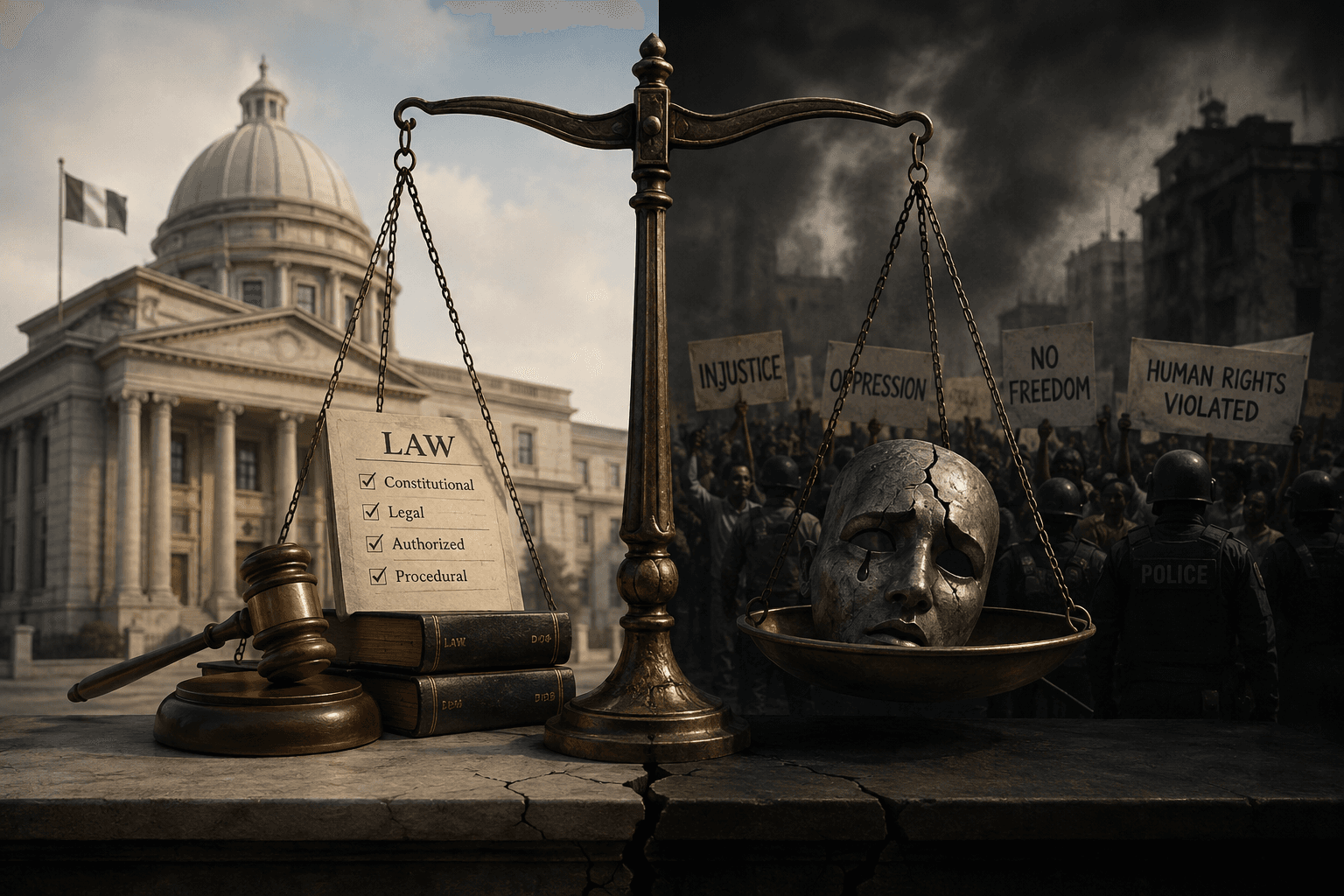
Can a government be legal and still be unjust?
It sounds like a contradiction.
After all, if an action is authorised by law, shouldn't that automatically make it right?
Not necessarily.
Law gives government power, but it also gives that power boundaries.
A government does not exist merely to possess authority. Its authority is exercised within a constitutional framework built around principles such as the rule of law, separation of powers, accountability, equality, freedom and justice.
And perhaps that is where the distinction begins.
Something can be legal without necessarily being just.
Legality asks:
“Is this permitted by law?”
Justice asks a much harder question:
“Is this fair, reasonable and consistent with the principles we claim to uphold?”
The distinction matters because government has an enormous capacity to affect ordinary lives.
The laws passed by lawmakers can determine what people may or may not do.
The actions of the executive can affect liberty, property, security and everyday life.
The courts can determine whether governmental actions withstand legal scrutiny.
That is precisely why constitutional government cannot simply mean giving people in power the authority to act.
It must also mean placing limits on that authority.
The Nigerian Constitution itself does not present governmental power as limitless. It establishes the Constitution as the supreme law, distributes powers among the different arms of government, protects fundamental rights, and identifies freedom, equality and justice as foundational ideals of the Nigerian social order.
So perhaps the better question is not merely:
“Does the government have the power to do this?”
But also:
“How is that power being exercised?”
Because power without accountability can become abuse.
Law without justice can become a tool of oppression.
And authority without limits can become something very different from governance.
A functioning constitutional democracy therefore requires more than governments that can point to legal authority.
It requires institutions capable of questioning that authority, citizens capable of demanding accountability, and laws that remain subject to the principles of the Constitution itself.
Perhaps the real measure of government is not simply whether it has the power to do something, but whether that power is exercised within the boundaries of law, accountability and justice.
So, can a government be legal and still be unjust?
No comments yet. Sign in to join the discussion.