Introduction
Peace is often described as the absence of war, but the Middle East shows how fragile it can be.
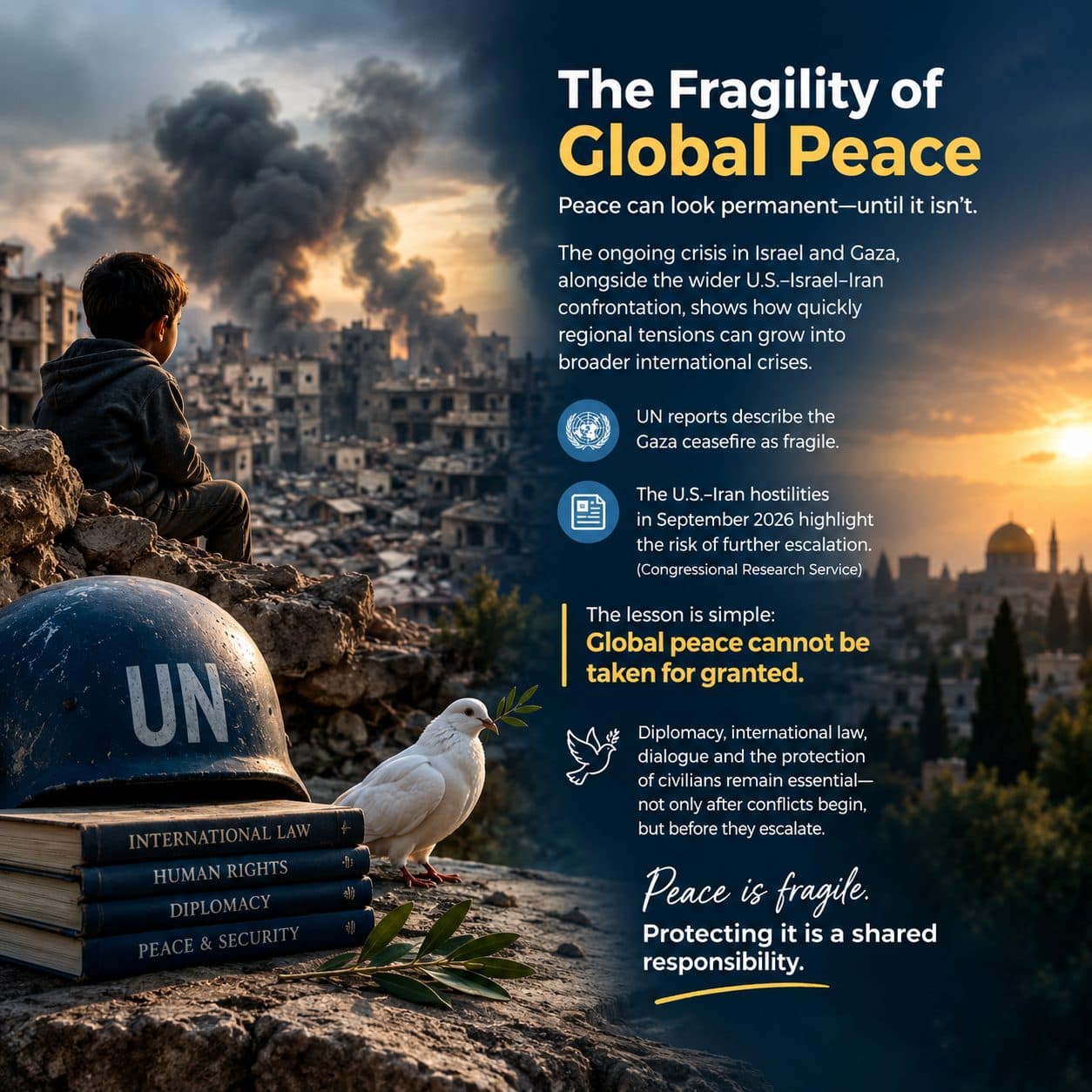
The Gaza conflict, Israel-Iran tensions and U.S. involvement demonstrate how quickly regional violence can have global consequences. The crisis raises a wider question:
How secure is global peace when international rules and institutions are under pressure?
Gaza: A Global Concern
The Gaza conflict shows that war affects civilians far beyond the battlefield.
As of September 2026, most of Gaza’s population remained displaced, while hostilities, civilian casualties and damage to infrastructure continued. Healthcare, water and sanitation were severely disrupted, and humanitarian organisations faced restrictions and funding shortages.
From Gaza to Iran
The conflict became more dangerous when it expanded beyond Gaza.
According to the Congressional Research Service, U.S. and Israeli strikes on Iran began on 28 February 2026, prompting Iranian retaliation across the region and affecting shipping and the Strait of Hormuz. Although ceasefires were reached, fighting later resumed.
This shows how quickly a local conflict can involve other states, alliances, economies and strategic infrastructure.
The United States and International Security
U.S. involvement highlights the influence of powerful states.
Washington can shape conflict and diplomacy, but military action raises questions about force, self-defence, sovereignty and legality. Disagreements over these issues make international cooperation difficult.
Iran and Regional Escalation
The Iran dimension increases the risk of wider instability.
The region contains major military powers, energy infrastructure and maritime routes. Disruption to the Strait of Hormuz and commercial shipping showed how conflict can create economic and humanitarian problems worldwide.
No major conflict is entirely local.
International Humanitarian Law
International humanitarian law requires distinction, proportionality and precautions in attack. Civilians and civilian infrastructure must be protected.
Attacks on power plants, water systems, hospitals, roads, homes and schools show the consequences of warfare without adequate limits.
A world where civilians live under constant threat is not secure.
The United Nations
The UN was created to maintain international peace and security, yet the Middle East shows the limits of collective security when diplomacy fails.
Security Council meetings remain important forums for managing conflict, even when they do not produce lasting settlements.
The Human Cost
Behind every strategic decision are human beings.
Civilians in Gaza continued to face death, displacement and worsening living conditions. War disrupts:
i. education;
ii. healthcare;
iii. housing;
iv. food and water;
v. families;
vi. mental wellbeing;
vii. trade; and
viii. regional stability.
The longer conflict continues, the harder reconstruction and reconciliation become.
Lessons for the World
The crisis shows that:
i. peace cannot be taken for granted;
ii. regional conflicts can become international;
iii. military power cannot ensure lasting peace;
iv. international law matters most during crises;
v. civilians bear the greatest cost; and
vi. peace requires more than a temporary ceasefire.
Conclusion
The fragility of world peace is evident in Gaza’s displacement, the conflict involving Iran, U.S. involvement, disrupted trade and the limits of international institutions.
The lesson is not that war is inevitable, but that peace requires constant protection.
Diplomacy, humanitarian law and international institutions must support negotiation, accountability and peaceful settlement.
Peace is not simply the absence of war.
It is the continuous effort to prevent war from becoming inevitable.
No comments yet. Sign in to join the discussion.