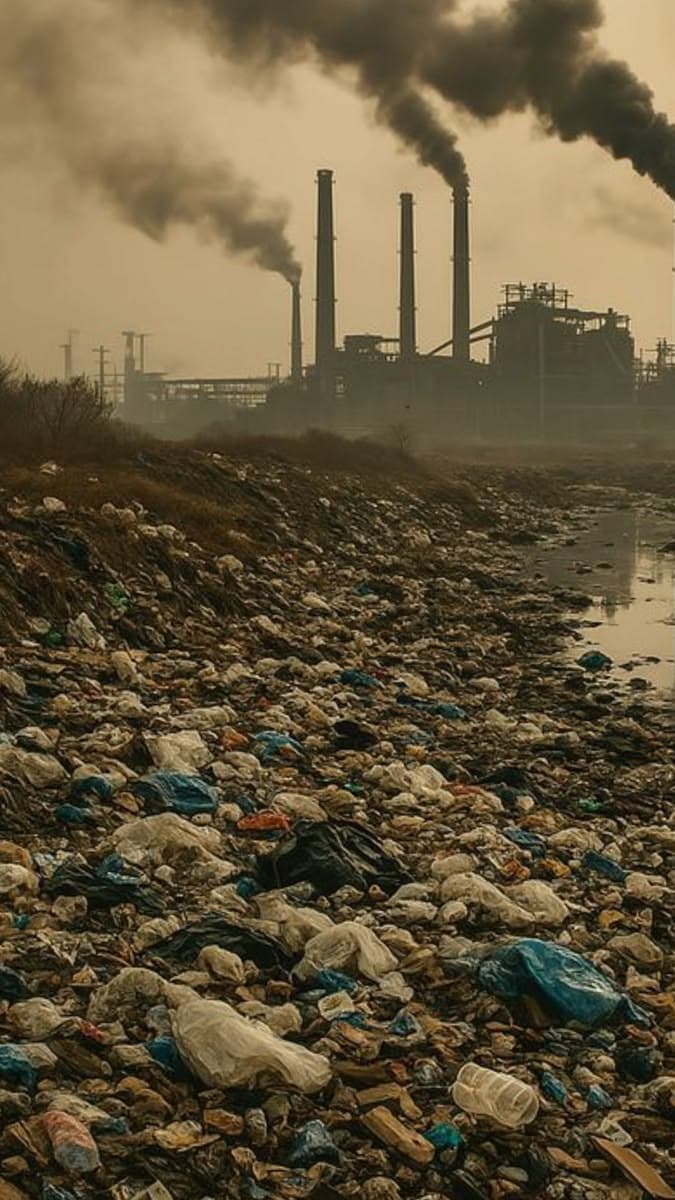
Green Industrialization, in my own opinion is a state of economic development and growth that doesn't harm the environment and ensures sustainable development. It's basically harmonizing the environment and recycling all waste to replenish the ecosystem rather than to pollute the environment and cause hazards in the ecosystem. This is something which ought to be achieveable not just in all parts of the world but particularly Africa, where we are still the continent that relies heavily on agriculture and natural resources to thrive.
I'm sure we've all heard of the 20 SDGs I'm certain we have all seen the recycle logo at the back of all wrappers and biscuits and drinks we take as refreshments, I'm sure we all know the impact of having a clean and neat environment but guess what how many of us are actually doing that? Now that's the question I want to answer in my work.
In recent times, we've seen some countries like utilizing natural resources and recycling waste materials and using that told develop their environments and economies and guess what, whilst they keep their major cities clean they use African Countries as a dumping ground and is this fair to us no, will it stop anytime soon without action no, what if we take action definitely yes.
We have to be clean and neat in our environment to ensure sustainable development, yes we know that but how many of us are actually doing that? Exactly not many, and this does not only affect us but the generations that come after, cleanliness is next to Godliness we know that but his many of us are actually clean, and I know a lot of us have a lot of accusing fingers to point at people, like the government for not making adequate and binding legislation to prevent pollution, industries for polluting the air, water and land , the traditional rulers for exposing rural areas to exploration and exploitation of natural resources in that location, how many of us actually blame ourselves for this misfortune we've put ourselves through?
Green industrialization will be possible in Africa if we firstly create awareness, because as a wiseman once said illiteracy is a very dangerous disease and if we look at most African Countries they are laws and international charters which have been enacted and domesticated bit hoe many citizens actually know about this? only a few, is it meant to be so? No.
The second thing is enforcement of sanctions, because basically, a legislation without punishment is a mere puff and lacks any legal enforceabilty and when something is a mere puff or lacks enforceabilty it will be easily flouted and seen as a joke to the citizens. Instead of embezzling government funds the governments of African States can basically create agencies to enforce environmental sanitation in the country and protect the lives and environments of humans and animals alike in the society and continent at large.
Moving further, foreign and indigenous companies that release nauseating and toxic smoke or oil and gas companies that flare gas or release smoke in the air, pollute the water and the environment should be given stricter sanctions by the government, this will ensure reduction in the rate of the pollution, the funds generated as fines can be used to alleviate the situation of the environment, cover the effects of pollution and prevent environmental degradation. The government can also liase with the companies to come about more safer and less hazardous ways of dispose industrial waste without harming the flora and fauna.
Finally, as individuals we need to do our part in allowing for an environment to be neat and sanitized by clearing dirty areas, we can even start small from even the biscuit nylons and wrappers we use and let's make sure we dispose them in dustbins and proper places, we should also learn to stop burning refuse in an open place, please and please a safe environment is a safe future and a sustainable one for the ones yet to be born.

"The second thing is enforcement of sanctions, because basically, a legislation without punishment is a mere puff and lacks any legal enforceability and when something is a mere puff or lacks enforceability it will be easily flouted and seen as a joke to the citizens." This is where, for me I think the article did best in. Funnily, we have the Bamako convention, 1991, yet its enforcement is mere puff like you said. The Bamako convention on the Ban of the Import into Africa and the Control of Transboundary Movement and Management of Hazardous Wastes within Africa was made to precisely address this. I love this piece because the problem is accurately presented as multifaceted across various society players. Many citizens do not quite understand the implication of a polluted environment, the government and corporations are concerned about their pockets. It is until our fishes die, water polluted, humans sick, resources barren before we know to take actions.
It is possible, when everyone does their part!!