A map is supposed to show us the world. But what happens when the way we represent the world influences how we understand it?
On 4th of September 2026, the United Nations General Assembly adopted a resolution supporting more accurate cartographic representation of the world's regions. The initiative, led by Togo on behalf of the African Group and supported by the African Union, received an overwhelming 164 votes in favour, one against and six abstentions.
At first glance, this may appear to be a technical issue about geography. It is, however, a much bigger conversation about Africa, education, perception and representation.
The Problem with the Familiar Map
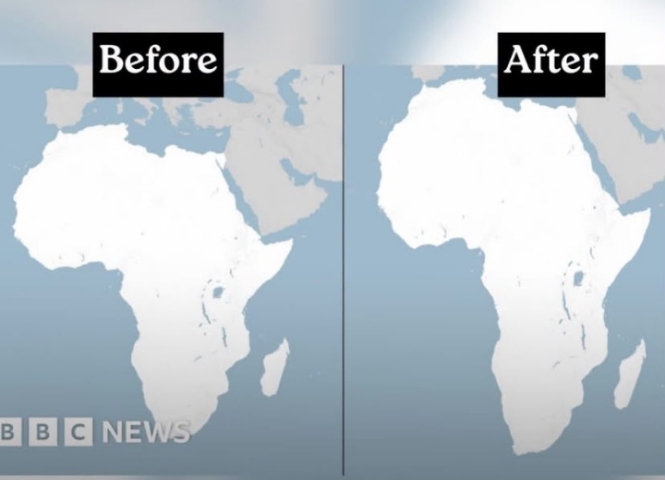
The Mercator projection, one of the world's most familiar map projections, was developed primarily for navigation. While useful for that purpose, it significantly distorts the apparent size of landmasses, particularly those farther from the Equator.
Consider Africa and Greenland. Africa is roughly 14 times larger than Greenland, yet on a conventional Mercator map, Greenland can appear comparable in size to Africa.
The geography has not changed. The representation has.
This distinction is important because the UN initiative does not mean that the Mercator projection is useless or illegal. Instead, it encourages the use of equal-area projections, such as Equal Earth, where accurately communicating the relative size of continents is important.
Why Education Matters
For many children, the classroom map is their first visual introduction to the world.
Before they understand geopolitics, economics or international relations, they learn to recognise continents through maps. What they repeatedly see can influence how they organise their understanding of the world.
This is why the initiative matters to African education.
It gives us an opportunity to teach students not only where countries are, but also how maps are created, what they preserve, what they distort and why those choices matter.
Geography should be more than memorising capitals and boundaries. It should help young people understand space, people, resources, history, environment and power.
The Significance of Togo
Perhaps the most inspiring part of this development is Togo's leadership.
Togo is not one of the world's largest or most powerful countries. Yet it helped take a question of cartographic representation to the highest level of international diplomacy.
That is an important lesson in leadership.
Influence is not always determined by size. Sometimes it begins with the courage to question what everyone else has accepted as normal.
Togo's initiative was not simply about making Africa appear larger. It was about accuracy and equitable representation.
And that distinction matters.
Africa does not need a map to make it important. Africa is already the world's second-largest continent by land area and home to enormous cultural, human and natural diversity.
What matters is ensuring that our maps, classrooms and narratives help people understand that reality accurately.
Beyond the Map
Correcting the map will not solve Africa's educational, economic or developmental challenges. But it can start an important conversation.
It encourages us to ask:
What else are we teaching simply because it is what we inherited?
Are our history books adequately telling African stories?
Are our educational materials reflecting African realities?
Are African voices sufficiently involved in shaping how Africa is represented?
These questions are bigger than cartography.
They are questions of education, identity and agency.
Togo has shown that leadership can begin with something as seemingly ordinary as a map. By challenging how the world is represented, it has encouraged a deeper conversation about how Africa is perceived — and how Africans perceive themselves.
A map may not change the geography of the world, but it can change the way we see it.
Perhaps that is the real significance of Correct the Map.
Not making Africa bigger, but making our understanding of Africa more accurate.
No comments yet. Start the conversation.