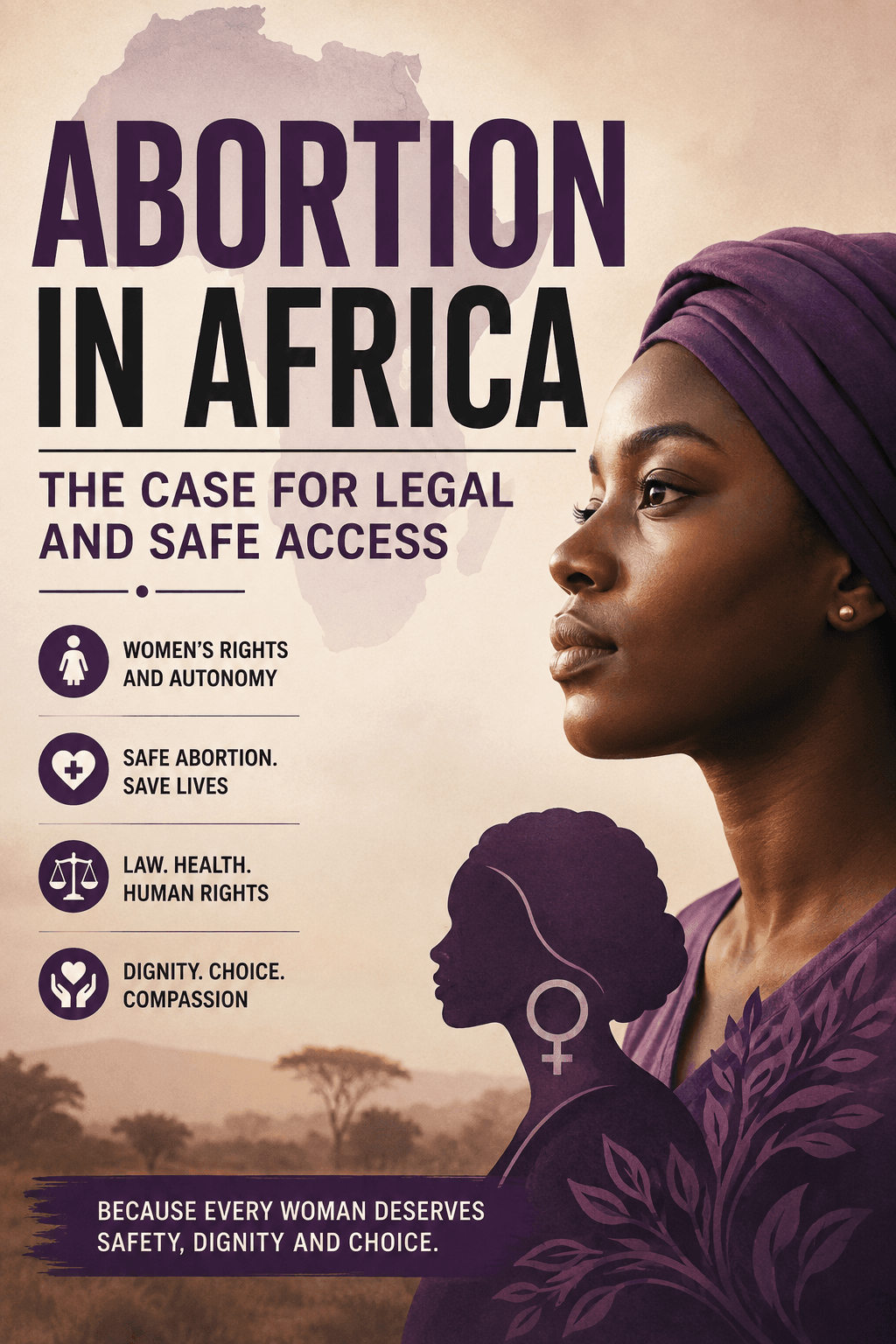
Abortion remains one of the most controversial social, legal, religious and public-health issues in Africa. Different African societies have different cultural and religious beliefs concerning pregnancy and the termination of pregnancy. While some people believe that abortion is morally unacceptable and should be prohibited, others argue that women should have the freedom to make decisions concerning their pregnancies, particularly where continuing a pregnancy would endanger their health, result from sexual violence, or impose serious social and economic consequences. The debate is therefore not simply about whether abortion should occur, but also about whether women who decide to terminate pregnancies should have access to safe medical services.
Abortion is a common healthcare intervention. According to the World Health Organization (WHO), approximately 45% of abortions worldwide are unsafe, and in Africa a large proportion of abortions occur under unsafe conditions. The WHO further explains that when abortion is performed using a recommended method appropriate to the duration of pregnancy and by a person with the necessary skills, it is a very safe healthcare intervention. However, when women cannot obtain safe, timely, affordable and respectful services, they may resort to unsafe methods.
This essay argues that African countries should move towards laws and policies that permit women meaningful access to abortion, while creating regulated healthcare environments in which abortion can be performed safely. Such an approach would protect women's autonomy and reproductive health while reducing the serious health consequences associated with unsafe abortion. Nigeria provides an important example because its existing criminal-law framework heavily restricts abortion, while Nigeria is also a party to the Maputo Protocol, which recognizes important reproductive-health rights for African women.
Abortion and Women's Autonomy
One of the strongest arguments for allowing abortion is the principle of bodily autonomy. Pregnancy has significant physical, psychological, social and economic consequences for a woman. Consequently, decisions concerning whether and when to have children are closely connected with a woman's personal liberty and reproductive autonomy.
The Maputo Protocol, formally known as the Protocol to the African Charter on Human and Peoples' Rights on the Rights of Women in Africa, recognizes this principle. Article 14(1) requires States Parties to respect and promote women's right to health, including sexual and reproductive health. It specifically recognizes the right of women to control their fertility and to decide whether to have children, as well as the number and spacing of their children.
This does not mean that abortion is an issue without moral significance. Abortion raises serious ethical questions about pregnancy, fetal life, religion and personal beliefs. However, in a pluralistic society, individuals do not necessarily share the same moral or religious understanding of abortion. The existence of disagreement therefore creates a strong reason for careful regulation and access to healthcare rather than policies that force every woman to follow one particular moral or religious position.
Women may seek abortions for many different reasons. Pregnancy may result from rape or incest; a pregnancy may threaten the woman's physical or mental health; a fetus may have a serious medical condition; or a woman may determine that she is unable to continue a pregnancy because of her personal circumstances. A legal system should therefore recognize that pregnancy does not occur in identical circumstances for every woman.
Unsafe Abortion as a Public-Health Problem
The most important practical argument for safe abortion access is the danger associated with unsafe abortion. Restrictive laws do not necessarily eliminate abortion. Instead, when women decide to terminate pregnancies but cannot obtain lawful medical services, some may seek assistance from unqualified persons or use methods that do not meet medical standards.
The WHO defines unsafe abortion as a procedure performed by persons lacking the necessary skills, in an environment that does not meet minimum medical standards, or both. Unsafe abortion can cause severe bleeding, infection, injury and other complications. It can also create significant social and financial consequences for women, families and healthcare systems.
The WHO further reports that deaths associated with safe abortion are extremely rare, while mortality associated with unsafe abortion can be very high in settings where unsafe procedures are common. It also emphasizes that restricting access to abortion does not reduce the number of abortions, but can influence whether the abortions women obtain are safe or unsafe.
This distinction is particularly important in Africa. A law may prohibit abortion, but prohibition does not necessarily prevent women from becoming pregnant unintentionally or from attempting to terminate pregnancies. The consequence can therefore be a situation in which abortion continues to occur outside regulated healthcare facilities. In such circumstances, the law may not achieve its intended objective of preventing abortion, while simultaneously exposing women to unnecessary health risks.
For this reason, governments should approach abortion not only as a moral or criminal-law issue but also as a public-health issue. Where abortion occurs, the state has a legitimate interest in ensuring that it does not result in preventable deaths, permanent injuries or untreated medical complications.
The Nigerian Legal Position
Nigeria provides an important example of the tension between restrictive abortion laws and the need to protect women's health. Nigerian abortion law is primarily governed by the Criminal Code in the southern part of the country and the Penal Code in much of the northern part.
Under section 228 of the Criminal Code Act, a person who, with the intention of procuring the miscarriage of a woman, unlawfully administers poison or another noxious substance, uses force, or employs another means to cause miscarriage commits a felony punishable by up to fourteen years' imprisonment. Section 229 similarly criminalizes a woman's attempt to procure her own miscarriage, with a possible sentence of seven years' imprisonment. Section 230 also criminalizes supplying substances or instruments knowing that they are intended to be unlawfully used to procure a miscarriage.
However, the Criminal Code also contains an important exception. Section 297 provides that a person is not criminally responsible for performing, in good faith and with reasonable care and skill, a surgical operation for the benefit of a person or upon an unborn child for the preservation of the mother's life, provided that the operation is reasonable in light of the patient's condition and circumstances.
The Penal Code contains a similar approach. Section 232 provides that voluntarily causing a woman with child to miscarry is punishable where the miscarriage is not caused in good faith for the purpose of saving the woman's life.
The Nigerian legal framework is therefore highly restrictive. It generally permits termination of pregnancy in circumstances connected with saving the life of the woman, rather than providing broad access based upon a woman's choice. This creates a significant gap between Nigeria's domestic abortion law and broader arguments concerning reproductive autonomy and public-health protection.
A reform of Nigerian abortion law could therefore focus on expanding the circumstances in which abortion is legally available, while maintaining appropriate medical regulation. Such reform would not necessarily require an absence of regulation. Instead, abortion could be governed by clear rules concerning healthcare providers, informed consent, pregnancy duration, medical standards, confidentiality and post-abortion care.
The Maputo Protocol
The Maputo Protocol is particularly important when considering abortion in Africa. It was adopted in Maputo, Mozambique, on 11 July 2003 and entered into force on 25 November 2005. Nigeria is among the African countries that have ratified the Protocol.
Article 14 of the Protocol concerns health and reproductive rights. Article 14(1) recognizes women's sexual and reproductive health rights, including the right to control fertility and decide whether to have children. Article 14(2)(a) also requires States Parties to provide adequate, affordable and accessible health services, including information and education, particularly for women in rural areas.
Most importantly, Article 14(2)(c) requires States Parties to protect women's reproductive rights by authorizing medical abortion in cases of sexual assault, rape and incest, and where continuation of the pregnancy endangers the mental or physical health of the mother or the life of the mother or fetus.
The significance of this provision is that the Maputo Protocol expressly connects abortion with women's reproductive rights and health. It also requires African states that are parties to the Protocol to take appropriate measures to make the recognized reproductive-health rights meaningful in practice. The African Commission's interpretation of Article 14 has emphasized the need to remove legal, administrative and institutional barriers that prevent women from accessing safe abortion within the circumstances recognized by the Protocol.
Therefore, Nigeria's participation in the Maputo Protocol provides an important regional human-rights framework for discussions about reforming its abortion laws. While the Protocol does not simply establish an unlimited right to abortion in every circumstance, it clearly requires protection of reproductive rights and access to medical abortion in specified circumstances.
The Need for a Safe and Regulated Environment
Legal reform alone is not enough. If African countries permit abortion but fail to establish functioning healthcare systems, women may still experience significant barriers to safe care. Governments must therefore create an environment in which women can obtain reliable information, qualified medical care and appropriate follow-up treatment.
First, abortion services should be provided by properly trained healthcare professionals in facilities that meet appropriate medical standards. The WHO's abortion-care guidelines emphasize evidence-based and quality abortion care and recognize that different healthcare workers can safely provide abortion care when appropriately trained and supported.
Second, services should be affordable and geographically accessible. Women in rural areas should not be forced to travel unreasonable distances before obtaining reproductive healthcare. The Maputo Protocol itself emphasizes adequate, affordable and accessible health services, particularly for women in rural areas.
Third, confidentiality should be protected. Fear of exposure, stigma and discrimination may discourage women from seeking healthcare. A woman seeking reproductive healthcare should be treated with dignity and should not be subjected to humiliation or unnecessary disclosure of private information.
Fourth, governments should provide accurate sexual and reproductive-health education. Access to contraception and accurate information can reduce unintended pregnancies and therefore reduce the number of abortions that women may seek. Abortion access should therefore form part of a broader reproductive-health strategy rather than being treated as an isolated issue.
Finally, post-abortion care should be available. Even where abortion is legally restricted, women who experience complications must be able to obtain emergency medical treatment without fear of punishment. A healthcare system that prioritizes saving lives should ensure that women experiencing complications receive appropriate treatment.
Addressing Moral and Religious Objections
Opposition to abortion in Africa is often influenced by religious, cultural and moral beliefs. Many Christians, Muslims and members of traditional communities believe that unborn life deserves protection and therefore oppose abortion. These beliefs deserve recognition in a democratic society.
However, recognizing moral disagreement does not require the state to ignore the consequences of unsafe abortion. A person may personally believe that abortion is morally wrong while still supporting policies that prevent women from dying from unsafe procedures.
The purpose of a public-health policy should be to reduce preventable death and injury while respecting the diversity of beliefs within society. Governments can therefore protect freedom of religion and conscience while establishing a legal healthcare framework that allows women to obtain safe abortion services under defined circumstances.
Moreover, supporting access to safe abortion does not mean encouraging abortion as a substitute for contraception or responsible sexual behaviour. Governments can simultaneously promote abstinence where appropriate, comprehensive sexual education, responsible sexual behaviour, contraception, family planning and safe abortion services.
Abortion Access and Gender Equality
Abortion restrictions can also be examined through the principle of gender equality. Pregnancy affects women physically in a way that it does not affect men. When access to reproductive healthcare is restricted, women consequently bear many of the direct health consequences.
The Maputo Protocol was created specifically to strengthen the protection of women's rights in Africa. The African Union describes it as a women-specific instrument designed to address discrimination and promote and protect women's rights.
Access to reproductive healthcare can therefore contribute to women's ability to participate in education, employment and public life. An unintended pregnancy can significantly affect a woman's education and economic opportunities, particularly where childcare and social-support systems are limited.
A woman's reproductive choices should consequently be considered within the broader struggle for equality. Women cannot fully participate in society if they lack meaningful control over decisions that have major consequences for their bodies, health and future.
A Better Approach for African Countries
African governments should adopt a balanced approach that combines legal reform, healthcare provision and prevention. First, laws should be reviewed to ensure that women can access safe abortion at least in all circumstances recognized by regional human-rights obligations, including rape, incest, sexual assault and threats to the woman's physical or mental health or life.
Second, countries should consider broader decriminalization and regulation of abortion so that women are not forced into dangerous underground procedures simply because they cannot satisfy unnecessarily restrictive legal requirements.
Third, governments should invest in reproductive healthcare, particularly in rural and underserved communities. Healthcare workers should receive appropriate training, and medical facilities should have the medicines, equipment and referral systems required for safe care.
Fourth, contraception and family-planning services should be strengthened. Preventing unintended pregnancy is an important part of reducing the demand for abortion.
Finally, governments should address the stigma surrounding abortion. Women who seek abortion should not be treated as criminals or social outcasts when they are accessing healthcare that the law permits. A respectful healthcare environment can encourage women to seek professional assistance earlier, reducing the likelihood of serious complications.
Conclusion
The debate surrounding abortion in Africa involves complex questions of morality, religion, law, women's rights and public health. Nevertheless, the existence of moral disagreement should not prevent governments from addressing the very real dangers associated with unsafe abortion.
The Nigerian legal framework currently permits abortion only within narrow circumstances, principally where it is connected with preserving the woman's life. Sections 228–230 of the Criminal Code criminalize unlawful attempts to procure miscarriage, while section 297 recognizes a limited exception for operations performed in good faith for the preservation of the mother's life. The Penal Code similarly restricts abortion while recognizing an exception where it is performed in good faith to save the woman's life.
At the regional level, however, the Maputo Protocol provides a stronger framework for women's reproductive rights. Article 14 recognizes women's right to control their fertility and requires medical abortion to be authorized in circumstances including rape, sexual assault, incest and threats to the woman's health or life. Nigeria's ratification of the Protocol makes it an important part of the country's regional human-rights obligations.
Ultimately, the objective of African abortion policy should be to protect human life and health while respecting women's autonomy and dignity. Criminalization alone cannot guarantee that abortion will disappear. A more effective approach is to prevent unintended pregnancies through education and contraception, while ensuring that women who do seek abortion can obtain safe, affordable, confidential and medically appropriate care. Creating such an environment would reduce unsafe abortion and its preventable consequences and would represent a stronger commitment to women's health, dignity and human rights.
References
African Commission on Human and Peoples' Rights. (2014). General Comment No. 2 on Article 14(1)(a), (b), (c) and (f) and Article 14(2)(a) and (c) of the Protocol to the African Charter on Human and Peoples' Rights on the Rights of Women in Africa. African Union.
African Union. (2003). Protocol to the African Charter on Human and Peoples' Rights on the Rights of Women in Africa (Maputo Protocol). African Union.
Federal Republic of Nigeria. Criminal Code Act, Cap. C38, Laws of the Federation of Nigeria 2004, ss. 228–230, 297.
Federal Republic of Nigeria. Penal Code (Northern States) Federal Provisions Act, Cap. P3, Laws of the Federation of Nigeria 2004, s. 232.
World Health Organization. (2025). Abortion. World Health Organization.
World Health Organization. (2025). Abortion care guideline (2nd ed.). World Health Organization.
United Nations Treaty Collection. (2003). Protocol to the African Charter on Human and People's Rights on the Rights of Women in Africa: Status of Treaties. United Nations.
This is brillianttttt😭💕🥹
Thank you 😊