One would be amazed by some photos that have been making the rounds online. Part of these weird photos is one where a young Nigerian man dressed in traditional attire is standing beside an older white woman he now calls his wife. The comments are predictable: jokes, mockery, and moral judgment.
But if we look past the punchlines, there is a harder question one begins to ask: what does it say about a country when its young men feel their most viable path to stability runs through a stranger's passport rather than their own economy?.
This new trend among our youths is one hundred per cent survival strategy. Sadly, it is one of the many horrendous means by which our hardworking and industrious youths' lives are wasted. I said hardworking and industrious because I understand the level of mental and intellectual work these people put in, along with years of commitment, before getting a dying white woman to agree to such a thing.
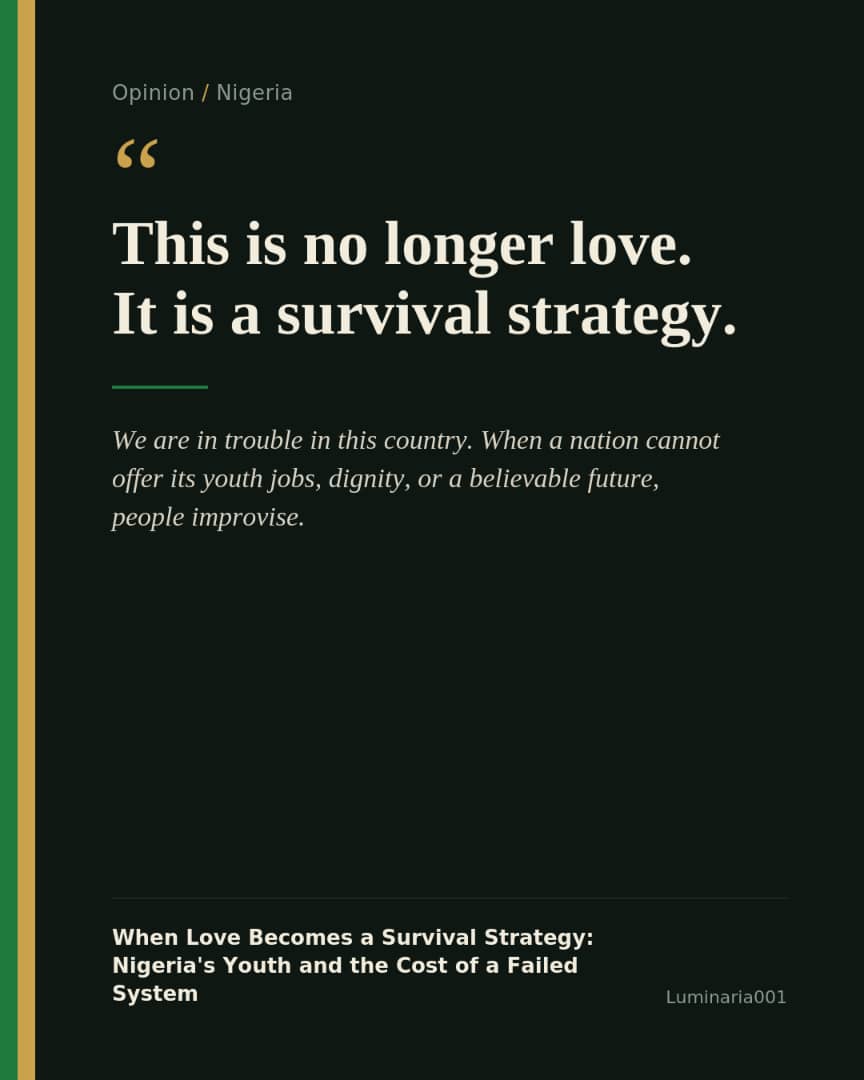
This isn't really about one couple or one photo. It's a symptom. When a nation can not offer its youth good jobs, dignity, or a believable future, it is only natural that people will improvise. Some travel through the desert. Some take "Japa" flights they can barely afford. Some build relationships — romantic or transactional or somewhere in between that outsiders are quick to laugh at but slow to understand. Call it what you want, but it is, for many, a rational response to an irrational situation.
The very many of our elites have always tagged us with the insult of "Lazy Youths". It has never sat right with me and many others that Nigerian youth are branded lazy by the same political class that has spent decades failing to build the industries, infrastructure, or institutions that would let ambition translate into opportunity.
Many young people are navigating this conundrum economy even if it involves hustling in the informal sector, building relationships across borders and learning skills online because the school system won't teach them. So tell me, how is it that some bourgeoisie will package them as being lazy? It is rather rhetoric. Our youths are improvising survival in real time, with no safety net and no margin for error.
Nigeria's leadership has a habit of tone-deaf commentary that lands especially badly against this backdrop. Remarks urging citizens to waste less food or comparisons that trivialize the gap between a struggling almajiri and a salaried worker who is himself barely getting by. These aren't just poor word choices; they reveal a leadership class that has lost the thread of what ordinary life costs in this country.
I am sincerely tired of complaining about some of the statements of our leaders, most especially those in positions of leadership and rulership. I think in my mind that it will be right to say that these gerontocrats are not with us. They are not in touch with our reality. They don't know what an ordinary Nigerian goes through to survive every day. Hence, why we hear them say things that should not have been said.
Many have been asking me, Luminaria001, what must we do to make a change? I think this is not the right question we should be asking at this point. The litmus question is, if at all we are serious about doing that, which is right and good, we must ask: Are we ready? Are you ready? Am I ready to make a change? If we are ready to do that which is good and right, then we must do this little thing.
Nigeria must be completely revolutionized and reconstituted. Power must change hands. The current elite must be replaced by a new one.
This is not new — it happened in America. The first shift came after the economic collapse and the Wall Street crash of the Great Depression. The second came after 9/11. Many overlook these, but they were both systematic revolutions that redefined power.
Nigeria needs that same systematic shift. Although, many Niger–pessimist have held the view that it is not possible. But, it has never been lost on me that it is possible and it must be done because if it is not done, we are done for.
It's easy to demand that young people "do better" or "be the change they wish to see." The harder, more honest question is structural: are the conditions in place for that change to matter?
The future of Nigeria rests on the youth. We must stand together with one voice across all regions and be ready to sacrifice.
The Nigerian elite are brilliant and highly calculative.
If one has been paying attention, one will see the new trick: more states are bringing a few young people into government as SAs and media assistants. That's the new normal. They know that once a few of us are in power, the rest can't complain about being neglected. It's a smart way to silence us.
Nigeria doesn't need another appointment of hundreds of "Special Assistants" to quiet youth frustration with titles instead of power. It needs functioning industries, credible institutions, and a political class willing to actually hand over decision-making — not photo-ops — to the generation it keeps talking about but rarely listens to.
History offers a blunt lesson: major shifts in power rarely come from polite asking. They come when a critical mass decides the status quo is no longer survivable and organizes peacefully, persistently, and with unified purpose to demand something different. Nigeria's youth, scattered across regions and platforms, have the numbers. What's been missing is the coordination.
The question isn't whether change is needed. It's whether we're actually ready to organize for it rather than wait for the next headline to be outraged about.
I look forward to the day, therefore, when we will be ready to sacrifice our greed for the betterment of this country.
No comments yet. Sign in to join the discussion.