Loading your feed…
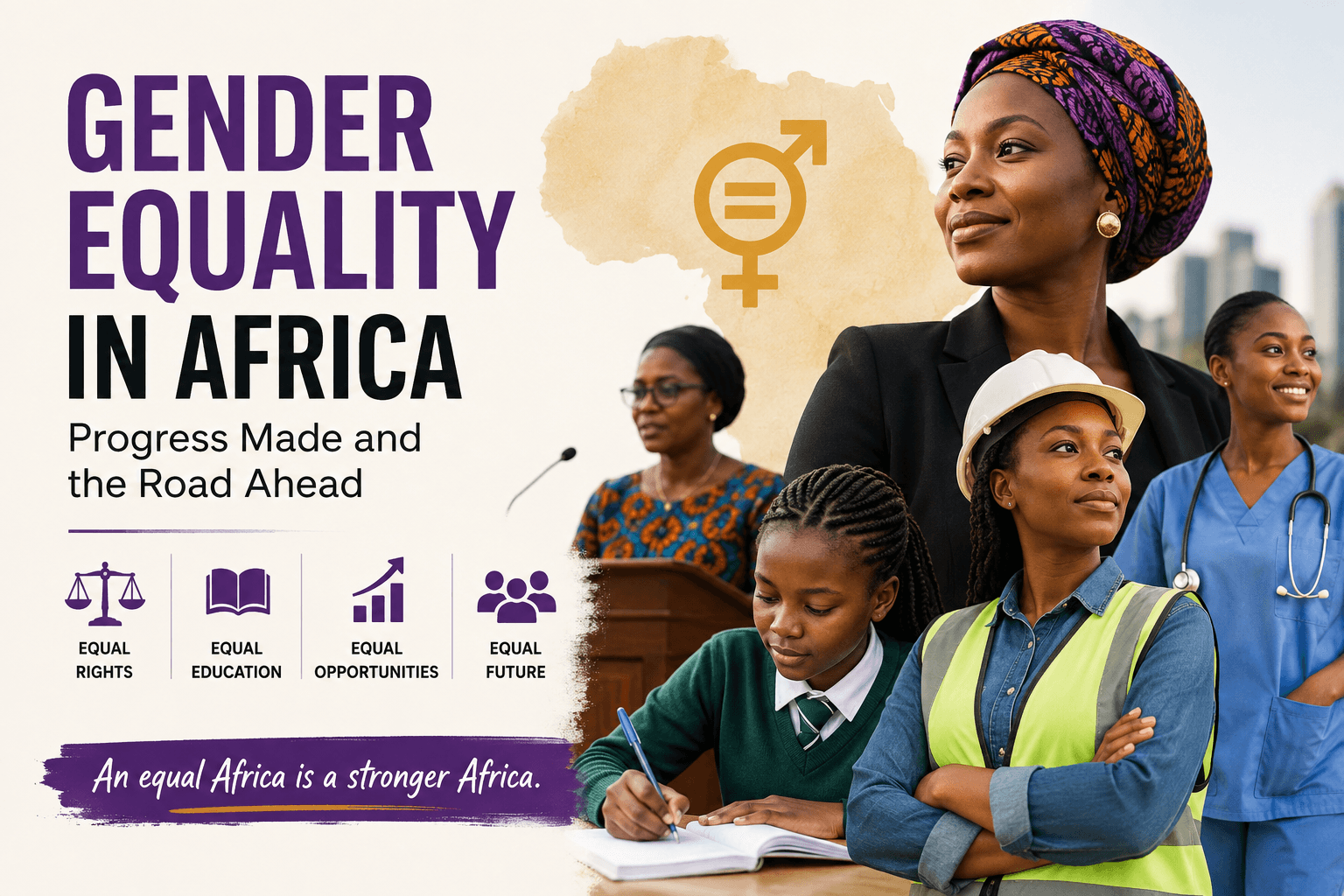
Gender Equality in Africa: Progress Made and the Road Ahead
Introduction
Gender equality is no longer simply a matter of fairness; it is a prerequisite for Africa's sustainable development. Across the continent, women and girls continue to make remarkable contributions to governance, entrepreneurship, education, agriculture, healthcare, science, and community development. Yet millions still face systemic barriers that limit their access to education, economic opportunities, political participation, and justice.
Over the past two decades, African governments, regional institutions, and civil society organizations have introduced policies aimed at advancing gender equality. Instruments such as the African Union's Agenda 2063 and the Protocol to the African Charter on Human and People's Rights on the Rights of Women in Africa reflect a continental commitment to protecting women's rights. Despite these achievements, implementation remains uneven, and gender inequality continues to affect the lives of millions.
For Africa to realize its full economic and social potential, gender equality must move beyond policy commitments and become an everyday reality.
Progress Worth Celebrating
Africa has recorded notable achievements in promoting gender equality. Several countries have increased women's representation in political leadership, demonstrating that inclusive governance is both possible and beneficial. More girls are enrolling in primary and secondary education than in previous generations, while women led businesses continue to expand across sectors such as technology, agriculture, finance, and manufacturing.
Across the continent, women entrepreneurs are creating jobs, driving innovation, and strengthening local economies. Young African women are increasingly visible in fields traditionally dominated by men, including engineering, law, medicine, and information technology. Digital platforms have also opened new opportunities for women to access education, markets, and financial services.
These successes demonstrate that when women are given equal opportunities, communities and economies benefit.
Persistent Challenges
Despite encouraging progress, gender inequality remains deeply rooted in many African societies.
Millions of girls still encounter barriers to completing quality education because of poverty, child marriage, cultural expectations, inadequate sanitation facilities in schools, and conflict. In some communities, girls are expected to leave school early to perform domestic responsibilities or enter marriage at a young age, limiting their future opportunities.
Economic inequality also remains significant. Women are disproportionately represented in informal employment, where incomes are lower and social protections are limited. Access to land ownership, credit, inheritance, and business financing continues to be more difficult for many women than for men, reducing their ability to build sustainable livelihoods.
Gender based violence remains one of the continent's most pressing human rights challenges. Domestic violence, sexual harassment, human trafficking, and harmful traditional practices continue to threaten the safety and dignity of women and girls. Although many African countries have enacted laws addressing these issues, weak enforcement and social stigma often discourage survivors from seeking justice.
Political participation presents another challenge. While women's representation has improved in some countries, decision making positions across governments, public institutions, and corporate leadership remain largely dominated by men. As a result, policies may not fully reflect the diverse experiences and needs of women and girls.
Why Gender Equality Matters for Africa's Future
Gender equality is not solely a women's issue. it is a development issue.
When girls receive quality education, they are more likely to become economically independent, participate in civic life, and contribute to healthier families and stronger communities. Women's economic participation increases household incomes, supports poverty reduction, and stimulates national economic growth.
Inclusive leadership also leads to more balanced decision making by incorporating diverse perspectives into governance and policy development. Societies that protect the rights of women and girls are generally more resilient, innovative, and prosperous.
Achieving gender equality also advances several global development priorities, including poverty reduction, improved health outcomes, quality education, decent work, and sustainable economic growth.
The Role of Law and Policy
Legal reforms remain essential to advancing gender equality across Africa. Governments must not only enact progressive legislation but also ensure effective implementation through strong institutions, adequate funding, and accessible justice systems.
Laws protecting women against discrimination, workplace inequality, gender based violence, and harmful practices should be consistently enforced. Equal access to education, healthcare, inheritance, property ownership, and financial services must be guaranteed in both law and practice.
Regional cooperation through African institutions can also encourage countries to share successful policies and strengthen accountability for gender commitments.
The Role of Young Africans
Young people have an important role in shaping a more inclusive Africa. Universities, youth organizations, media platforms, and community groups can challenge harmful stereotypes and promote gender equality through education and advocacy.
Young men should be active partners in advancing equality by rejecting discriminatory attitudes and supporting respectful relationships. Likewise, young women should continue to pursue leadership opportunities, education, entrepreneurship, and civic participation with confidence.
Social media has become a powerful tool for raising awareness, amplifying women's voices, and mobilizing action against injustice. When used responsibly, digital platforms can accelerate positive social change across the continent.
Recommendations
1.To accelerate progress, African governments and stakeholders should prioritize the following actions:
2.Strengthen enforcement of laws protecting women's rights.
3.Expand girl's access to quality education, particularly in rural and conflict-affected communities.
4.Increase investment in women's entrepreneurship through improved access to finance and training.
5.Implement stronger measures to prevent and respond to gender-based violence.
6.Promote women's participation in political and economic leadership.
7.Encourage partnerships between governments, civil society, educational institutions, and the private sector to advance gender equality.
Conclusion
Africa's future depends on the full participation of all its people. While significant progress has been made in promoting gender equality, important challenges remain. Policies alone cannot transform societies; lasting change requires collective action from governments, communities, institutions, and individuals.
Creating an Africa where women and men enjoy equal opportunities is not merely an aspiration.it is an investment in the continent's future. By removing barriers to equality and empowering women and girls to reach their full potential, Africa will be better positioned to achieve sustainable development, strengthen democratic governance, and build more resilient and prosperous societies.
Gender equality is not a favour extended to women. It is a fundamental principle of justice and a cornerstone of Africa's progress.




This is beautiful dear 💕 keep it up!!!
Thank you 😊